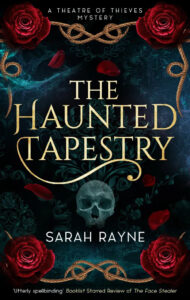
 To set the irrepressible Fitzglens in a haunted theatre for a new Theatre of Thieves mystery, was an alluring idea. So far they had dealt with doomed medieval treasures from the 13th century in Chalice of Darkness; coped with Tudor scandals and intriguing manuscripts in The Murderer Inside the Mirror, and grappled with scandalous secrets from the life of Catherine the Great in The Face Stealer. But they had not yet confronted any adversaries from the spirit world. The problem, though, was whether a genuine, historically-accredited spook should be used in the plot – and, if so, which spook it should be, because most theatres have such a comprehensive cast of ghosts it might almost be necessary to hold auditions.
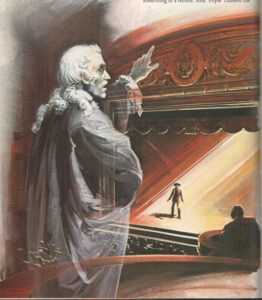
Drury Lane’s “Man in Grey”
Most actors recount with delight how all theatres have ghosts, usually starting with Drury Lane’s famous ‘Man in Grey’ – the nattily-clad apparition who sports a powdered wig, grey cloak and three-cornered hat. According to the tales, he crosses from one side of the upper circle to the other, then usually melts politely into a wall before any action on stage can be interrupted – which does indicate consideration towards the players.
The shade of the capering Regency comedian, Joe Grimaldi, is said to wander around backstage, occasionally taking it upon himself to administer an unexpected kick to the hind quarters of players awaiting their entrance – sometimes precipitating them onto the stage with unrehearsed vigour.
At a humbler level, are spectral chars, eternally trying to scrub out fake blood after Macbeth’s death, and phantoms who obligingly pass the backstage staff a stage brace, before vanishing in a puff of histrionic vapour.
But whatever their shape and behaviour, most actors are rather proud of their ghosts. An obscure music hall song not only gives a nod to them, but also celebrates a colloquialism in which actors refer to ‘the ghost walking’ – which translates as the paying of their wages:
 “On Friday nights the ghost walks
Rattling its chains to itself;
For that’s the night the ghosts hands out the pelf.
On Friday nights the ghost walks
Always as white as a sheet.
Cheerless as sin, so they buy it some gin and some bedsocks for its feet.”
But none of these tales – albeit entertaining and often quite well documented – seemed to fit the Fitzglens and their secret activities as society burglars when off-stage. So I wondered whether it would be possible to create an entire new ghost for them. It would need its own setting, of course – ideally an abandoned theatre so hung about with dark legends, that no actor had set foot on its boards for over a century – and consequently providing a splendidly eerie setting for a new chapter in the Fitzglen chronicles.
With this thought, a shadowy but tempting outline began to form on the edges of the half-written plot. The shadow – and gradually the substance – of an old and suitably creepy theatre took on life. Byron Fitzglen, who is the academic member of the clan and an immensely useful character to an author, thought it could be called The Skene, explaining that the word comes from the ancient Greek term for the structure at the back of the stage – skene. And apparently our word today, proscenium, is a Greek derivative – coming from proskenion.
At that stage, with plot notes scribbled on odd bits of paper, it was already becoming clear that The Skene could be very acceptably haunted. But what form should its ghost take? And how should it make its appearance? On the stage itself – eliciting gasps of horror from the audience, swoons from the ladies in the stalls, and probably catcalls from the gallery? Might it steal onto the boards during the denouement scene of a murder mystery, thereby complicating the unfrocking of the villain, and bewildering not only the audience, but also the players? Or could it step down from some kind of portrait?
Or, if not a portrait, what about a tapestry?
The idea of a tapestry in which dwelled a watchful and possibly vengeful ghost instantly appealed to me. Traditionally, tapestries are pictorial accounts of legends and tales and histories. The Bayeux Tapestry came instantly to mind, of course, but a work of fiction – however gothic – could hardly describe marauding Normans leaping enthusiastically down from the canvas and roaming the stalls or buying drinks in the crush bar at the interval. Nor could the Apocalypse Tapestry come to life, allowing the Four Horsemen to gallop through the wardrobe store.
But there seemed no reason why a fictional tapestry could not be created – a piece of work that held in its embroidered depths, clues to the truth about a dark and dangerous secret. The secret would have to be a murder, of course – but a murder that had had to be kept secret because it had involved the highest in the land. A murder that had resulted in a killer’s likeness – and also the victim’s – being trapped in the tapestry. But likenesses that occasionally stirred within the silk and wool and embroidery to hint to future generations about an astonishing crime that the history books never dared mention.
And so the eerie Silentium Tapestry – the “Tapestry of Silence” – was born, and the plot for THE HAUNTED TAPESTRY finally came into being. And Book Four of the Fitzglen series was written.